Days of the week in Arabic Language
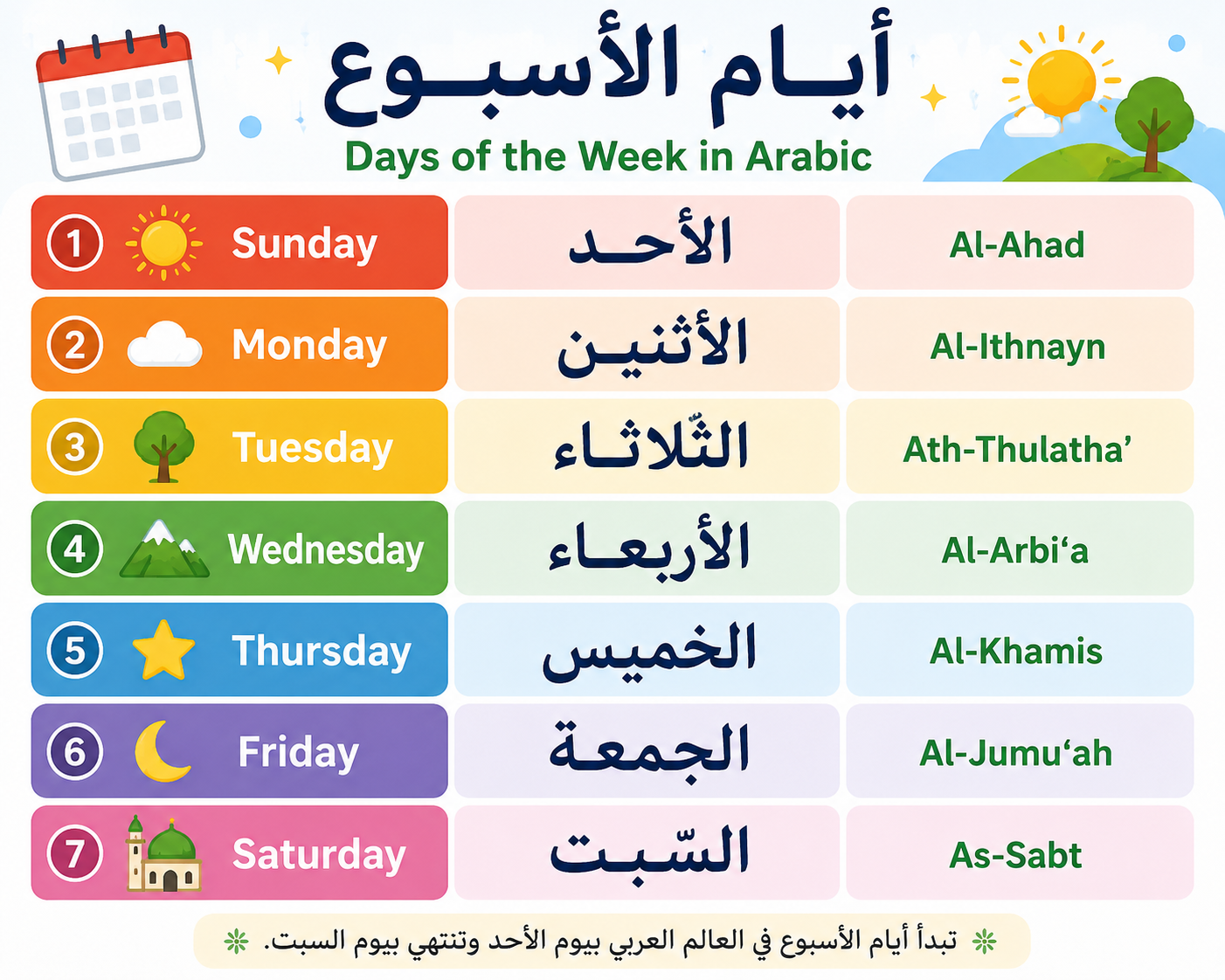
In this lesson, we will Discuss about Days of Week in Arabic Language. Day is translated as “Yaum” in Arabic Language. Days in Arabic are based on counting as first day is called Al-Ahad. Ahad means one i.e First day of the week. Same rule apply on all days except Friday, Friday is called Juma same like urdu language. As we know there are seven days in a week. Learn how to say Monday, Tuesday, Wednesday, Thursday, Friday, Saturday, Sunday in Arabic Language. How to say days of week in Arabic.
Learning the days of the week in Arabic is one of the easiest ways to build a strong foundation in everyday Arabic. Whether you are planning to travel to an Arabic-speaking country, communicating with Arabic speakers, studying the language, or simply expanding your vocabulary, knowing the days of the week helps you talk about appointments, work, school, travel, and daily routines.
The days of the week in Arabic follow a simple pattern. Several Arabic day names are connected with numbers, which makes them easier to remember. With regular practice, you can quickly learn how to say Monday, Tuesday, Wednesday, and the other days naturally.
In this lesson, you will learn the Arabic names of all seven days, their pronunciation, English meanings, and Hindi translations. You will also see simple examples that show how to use these words in everyday Arabic conversations.
How to say the Days in Arabic (أيام الأسبوع)
| Arabic Name | Arabic Pronunciation | English | Hindi |
| الأحد | (al-ahad) | Sunday | रविवार |
| الإثنين | (al-ithnayn) | Monday | सोमवार |
| الثلاثاء | (al-thulatha) | Tuesday | मंगलवार |
| الأربعاء | (al-arba’a) | Wednesday | बुधवार |
| الخميس | (al-khamees) | Thursday | गुरूवार |
| الجمعة | (al-juma’a) | Friday | शुक्रवार |
| السبت | (as-sabt) | Saturday | शनिवार |
Today is Sunday is translated as اليوم هو الأحد Al yaum hu ahad
Tomorrow is Sunday is translated as غدا الأحدghadan al’ahad
Yesterday was Sunday is translated as البارحة كان الأحد albarihat kan al’ahad
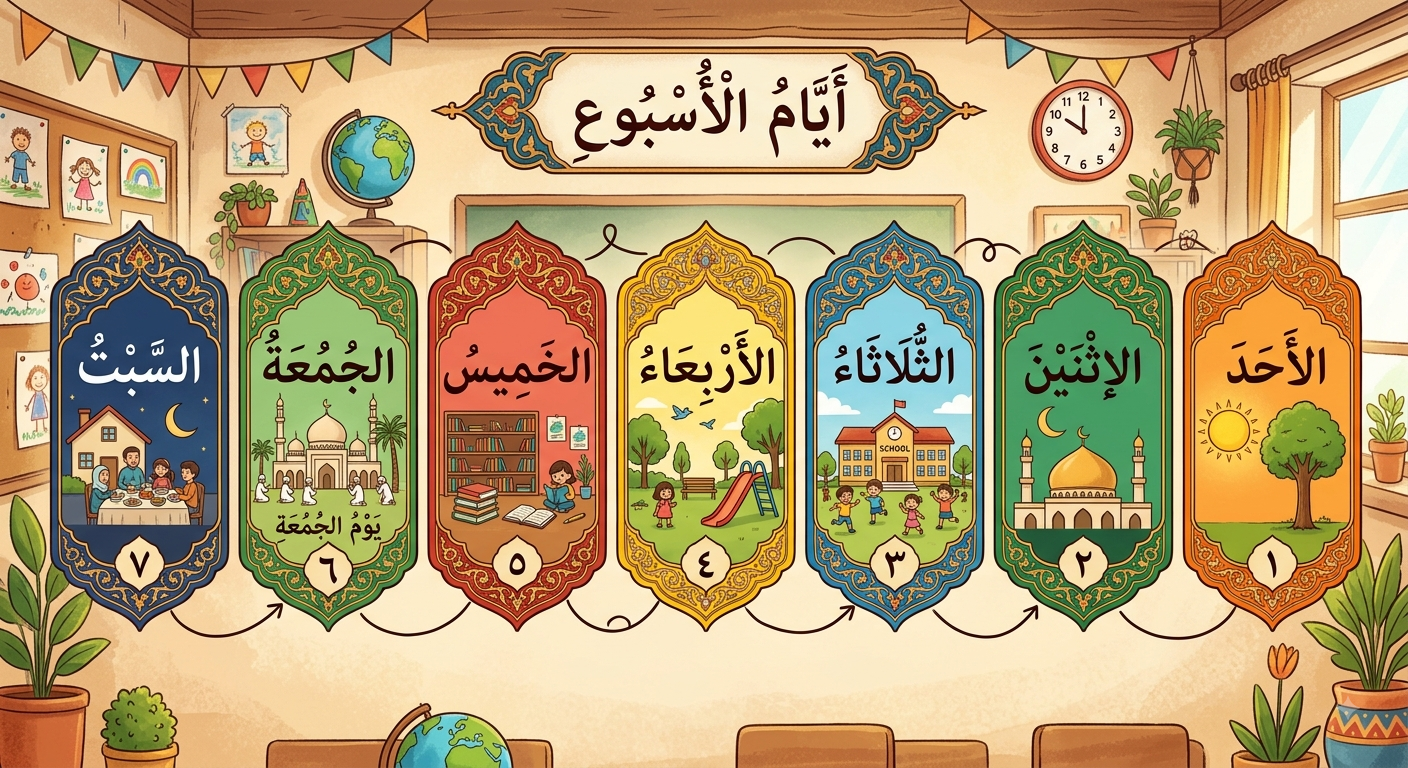
Days of the Week in Arabic
Days of the Week in Arabic
Arabic is written from right to left. Therefore, the Arabic names may look different from their English equivalents. However, once you become familiar with the Arabic script and pronunciation, the vocabulary becomes much easier to remember.
Here is a complete list of the days of the week in Arabic:
| Arabic | Pronunciation | English | Hindi |
|---|---|---|---|
| الأحد | al-Aḥad | Sunday | रविवार |
| الاثنين | al-Ithnayn | Monday | सोमवार |
| الثلاثاء | ath-Thulāthā’ | Tuesday | मंगलवार |
| الأربعاء | al-Arbi‘ā’ | Wednesday | बुधवार |
| الخميس | al-Khamīs | Thursday | गुरुवार |
| الجمعة | al-Jum‘ah | Friday | शुक्रवार |
| السبت | as-Sabt | Saturday | शनिवार |
Sunday in Arabic – الأحد
Sunday is called الأحد in Arabic. Its pronunciation is approximately al-Aḥad. The word is related to the Arabic concept of “one,” which makes it easier to connect with the first day in the traditional Arabic week.
For example, you can use الأحد when talking about plans, appointments, or weekly schedules.
Example:
اليوم الأحد.
Al-yawm al-Aḥad.
Today is Sunday.
Monday in Arabic – الاثنين
Monday is called الاثنين, pronounced al-Ithnayn. The word is associated with the number two in Arabic.
For beginners, Monday is particularly useful because it appears frequently in conversations about work, school, and weekly routines.
Example:
سأذهب إلى العمل يوم الاثنين.
Sa-adhhab ilā al-‘amal yawm al-Ithnayn.
I will go to work on Monday.
Tuesday in Arabic – الثلاثاء
Tuesday is الثلاثاء, pronounced ath-Thulāthā’. The name is connected with the Arabic number three.
The pronunciation may seem difficult at first because of the ث sound. This Arabic letter produces a sound similar to the th in the English word “think.”
Example:
لدي اجتماع يوم الثلاثاء.
Ladayya ijtimā‘ yawm ath-Thulāthā’.
I have a meeting on Tuesday.
Wednesday in Arabic – الأربعاء
Wednesday is called الأربعاء, pronounced al-Arbi‘ā’.
This word comes from the Arabic number four. Therefore, remembering the number pattern can help you memorize several days of the week in Arabic more quickly.
Example:
سأدرس يوم الأربعاء.
Sa-adrus yawm al-Arbi‘ā’.
I will study on Wednesday.
Thursday in Arabic – الخميس
Thursday is الخميس, pronounced al-Khamīs. It is another commonly used word in everyday Arabic conversations.
You may hear Thursday mentioned when people discuss their weekend plans, especially in countries where Friday and Saturday are traditionally the weekend.
Example:
سنلتقي يوم الخميس.
Sanaltāqi yawm al-Khamīs.
We will meet on Thursday.
Friday in Arabic – الجمعة
Friday is called الجمعة, pronounced al-Jum‘ah. Friday has special cultural and religious importance in many Arabic-speaking communities.
The word الجمعة is also associated with gathering or congregation.
Example:
يوم الجمعة يوم مهم.
Yawm al-Jum‘ah yawm muhimm.
Friday is an important day.
Saturday in Arabic – السبت
Saturday is السبت, pronounced as-Sabt.
It is the final day in the traditional sequence of the Arabic week and is commonly used when discussing weekend activities, school schedules, work, and travel.
Example:
سأسافر يوم السبت.
Sa-usāfir yawm as-Sabt.
I will travel on Saturday.
How to Remember the Days of the Week in Arabic
Learning all seven days of the week in Arabic becomes easier when you notice the number pattern.
Several Arabic day names are connected to numbers:
- الأحد — connected with one
- الاثنين — connected with two
- الثلاثاء — connected with three
- الأربعاء — connected with four
Then, the remaining names are:
- الخميس — Thursday
- الجمعة — Friday
- السبت — Saturday
Therefore, instead of memorizing seven completely unrelated words, learn the first four as a sequence and then memorize the final three separately.
Practice the Days Every Day
One effective method is to say the current day in Arabic every morning.
For example, if today is Monday, say:
اليوم الاثنين.
Today is Monday.
You can also write the Arabic day in your notebook and create one simple sentence with it. This small habit can significantly improve your vocabulary and confidence.
Useful Arabic Questions About Days
Once you know the days of the week in Arabic, you can start asking simple questions.
What day is today?
ما هو اليوم؟
Mā huwa al-yawm?
What day is today?
Today is Monday.
اليوم الاثنين.
Al-yawm al-Ithnayn.
Today is Monday.
What day is tomorrow?
ما هو يوم الغد؟
Mā huwa yawm al-ghad?
What day is tomorrow?
What day was yesterday?
ما هو يوم أمس؟
Mā huwa yawm ams?
What day was yesterday?
These simple questions are useful for beginners because they allow you to practice the vocabulary in real conversations.
Days of the Week in Arabic: Quick Review
Here is a quick revision before you move on:
الأحد — Sunday — रविवार
الاثنين — Monday — सोमवार
الثلاثاء — Tuesday — मंगलवार
الأربعاء — Wednesday — बुधवार
الخميس — Thursday — गुरुवार
الجمعة — Friday — शुक्रवार
السبت — Saturday — शनिवार
Try reading the list aloud several times. Then cover the English and Hindi translations and see how many Arabic names you can remember.
Frequently Asked Questions
What are the days of the week in Arabic?
The seven days are الأحد (Sunday), الاثنين (Monday), الثلاثاء (Tuesday), الأربعاء (Wednesday), الخميس (Thursday), الجمعة (Friday), and السبت (Saturday).
What is Monday called in Arabic?
Monday is called الاثنين and is pronounced approximately al-Ithnayn.
What is Friday called in Arabic?
Friday is called الجمعة, pronounced al-Jum‘ah. It is an especially significant day in many Arabic-speaking communities.
Which Arabic days are related to numbers?
Sunday through Wednesday have names connected with the numbers one through four: الأحد, الاثنين, الثلاثاء, and الأربعاء.
How can I memorize the days of the week in Arabic?
Start by learning the first four days as a number sequence. Then memorize الخميس, الجمعة, and السبت separately. Reading the words aloud and using them in simple sentences will make memorization easier.
Are Arabic days written from right to left?
Yes. Arabic uses a right-to-left writing system, so the Arabic names of the days are written from right to left.
Conclusion
Learning the days of the week in Arabic gives beginners a useful set of words for everyday communication. These seven words can help you discuss schedules, appointments, work, school, travel, and personal plans.
Start slowly and practice one or two days at a time. Then, gradually combine them in questions and sentences. Most importantly, use the words regularly. With consistent practice, the days of the week in Arabic will quickly become part of your active vocabulary.